
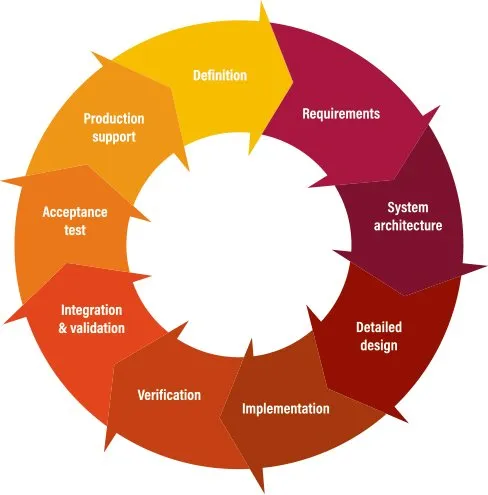
Definition
The design cycle starts with the definition of the project. These questions need to be answered. What are the main driving factors for the product, which project structure fits best? Is a proof of concept needed to mitigate risks?
Requirements
During this stage the requirements of the product will be determined. Besides the main functional aspects and specifications, focus is also on the non-functionals aspects such as compliance to regulation, performance requirements.
System architecture
When the definition of the product is clear, a decomposition of the design will be made to obtain the system architecture. In this stage the main technological solutions will be determined which enable to achieve the requirements.
Detailed design
During the detailed design stage for each of the competences (hardware, software) the design is worked out in more detail. This results in several detailed design documents for Software, Hardware and Interface description.
Implementation
With the detailed design documentation as starting point, the implementation phase will start. For the hardware this results in a schematic and PCB layout. For the software the actual coding is created. Last step of this process is to create prototypes of the product.
Verification
Goal of this stage is to verify the low-level behaviour of the prototypes. Main focus is on verifying if the functional blocks operate as described in the detailed design documentation.
Integration & validation
When the low-level functional blocks have been verified, the next step is to integrate these blocks into the end product, integrate software with hardware and mechanics.
Acceptance test
Goal of this stage is to validate if the design meets the requirements.
Product support
When the testing has been completed the design will be transferred to production. The Technical Product Documentation (TPD) which describes the product, will be handed over to production.
Production test tooling will be created to support the design for manufacturing.